
Introduction
The YouTube Ads playbook that worked in 2023 is already decaying. By 2026, relying on it will quietly burn your budget.
Rising CPAs, fewer manual controls, opaque optimization, and “trust the algorithm” advice have left many advertisers frustrated. You’re running campaigns, but you don’t feel in control. Performance fluctuates, attribution is fuzzy, and creative fatigue sets in faster than ever.
Here’s the hard truth: profitability in YouTube Ads is no longer a tactical problem. It’s a strategic one.
By 2026, winning advertisers will not outbid competitors — they will out-design them. Success will hinge on three pillars: AI-native creative that feeds the algorithm, hybrid conversion journeys that match fragmented attention, and privacy-first data strategies that fuel modeling instead of fighting it.
This guide is your forward-looking blueprint for how profitable YouTube advertising will actually work in 2026 — and how to start adapting now.
The 2026 Landscape: What Has Changed?
YouTube in 2026 is not a single placement — it’s an ecosystem.
Viewer attention is fragmented across Shorts, long-form, live streams, podcasts, and Connected TV (CTV). Viewers move fluidly between devices, contexts, and intent states — often within the same day.
At the same time, Google’s AI has become the dominant force in campaign execution:
- Performance Max–style automation is the default, not the exception
- Manual targeting and bidding controls are increasingly abstracted
- Creative, data signals, and measurement quality now matter more than “settings.
And then there’s data. Third-party cookies are functionally gone. Modeled conversions, consented first-party data, and probabilistic attribution are the norm.
The result?
Creative wear-out is faster
Average costs are higher
The margin for strategic mistakes is thinner.
This is the environment your 2026 YouTube Ads strategy must survive in.
Pillar 1: AI-Native Creative Is Your Primary Lever
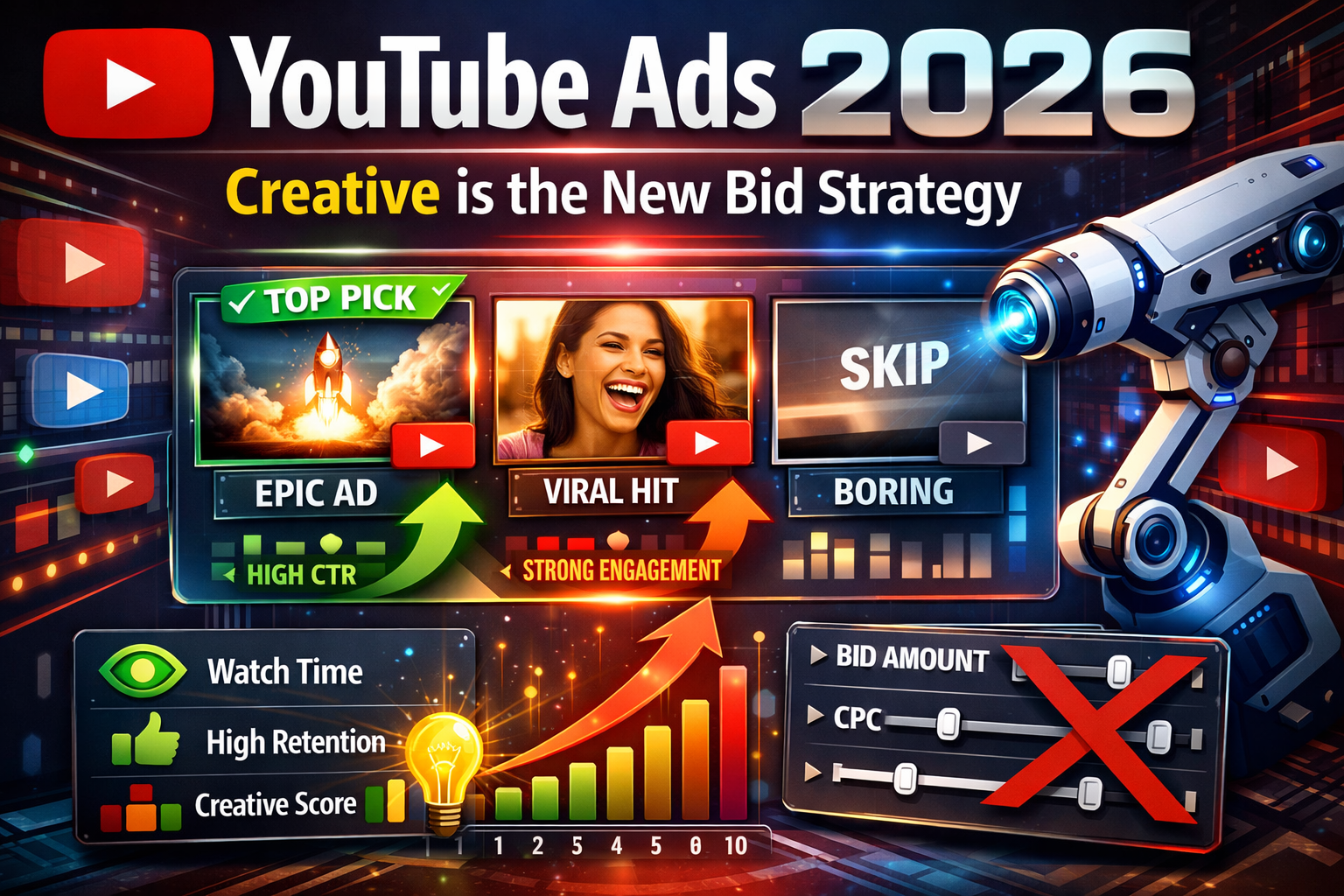
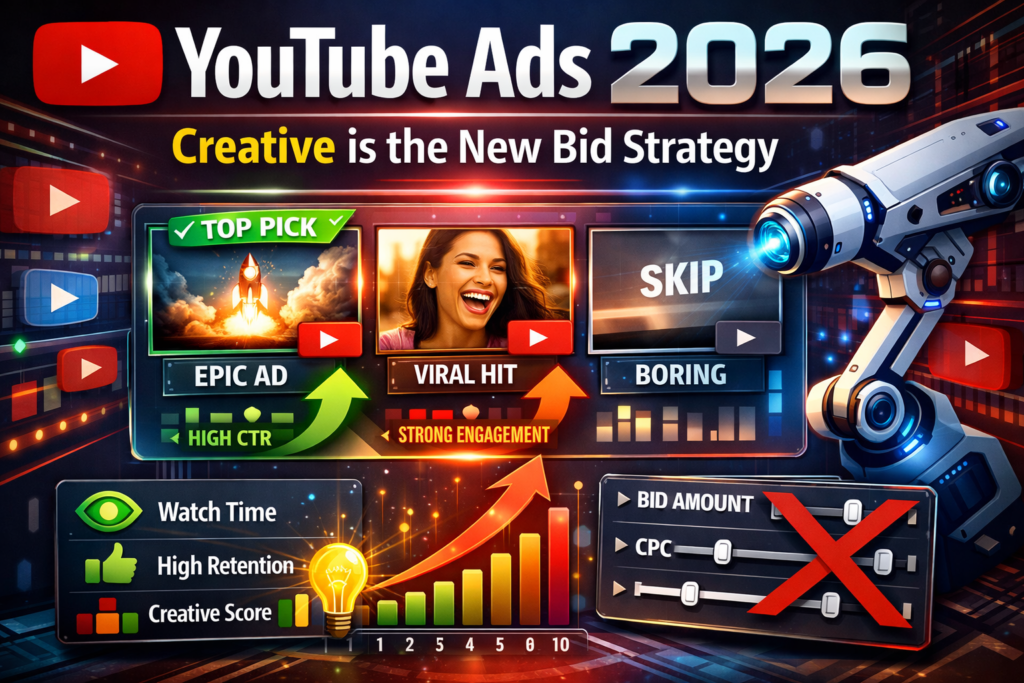
In an AI-optimized auction, your creative is no longer just messaging — it’s your bid.
Concept: Building for AI Interpretation
Google’s systems don’t just “watch” your video. They analyze:
- Spoken language
- On-screen text
- Visual themes
- Emotional tone
- Viewer engagement signals
In 2026, your creative must be explicitly interpretable by AI.
That means:
- Clear verbal framing of the offer in the first 5 seconds
- Text overlays that reinforce intent (“Free Demo,” “Compare Plans,” “Book a Call”)
- Consistent thematic clusters across variants (problem → solution → outcome)
Ask yourself: Is your creative built for humans only — or for humans and machines?
Production: The 2026 Video Asset Stack
Profitable advertisers will not run “a video.” They’ll run a system of assets:
- 3–5 second hook variants for skippable in-stream
- Vertical-first Shorts creatives optimized for thumb-stopping speed
- High-production brand narratives designed for CTV and living-room viewing
- Mid-length explainers that double as sales assets and remarketing fuel
AI-generated elements — b-roll, backgrounds, voiceovers, dynamic text — will be mainstream by 2026. Not to replace strategy, but to accelerate iteration.
Testing: Rapid Creative Iteration Loops
Creative testing is no longer quarterly. It’s continuous.
Winning teams will:
- Use AI tools to generate structured variations (hooks, CTAs, framing)
- Run in-platform YouTube video A/B tests aggressively
- Kill underperforming assets fast — before fatigue poisons the campaign
The goal isn’t perfection. It’s velocity.
Pillar 2: Designing Hybrid Conversion Journeys
The biggest mistake in 2026? Treating YouTube as either “branding” or “direct response.”
It’s both — simultaneously.
The Upper-Funnel to Direct-Response Continuum
A single video series can:
- Build trust on CTV screens
- Capture leads via desktop and mobile overlays
- Retarget high-intent viewers days later with shorter, sharper CTAs
Your strategy should assume non-linear conversion paths, not instant clicks.
YouTube as a Lead Gen Hub
By 2026, YouTube’s native lead tools are central to performance:
- Extended lead forms
- Auto-filled first-party fields
- Deeper CRM and Shopify-style integrations
These tools matter because they keep the conversion inside Google’s data ecosystem, improving modeling and optimization.
Off-Platform Nurturing
The click is not the conversion — the follow-up is.
Profitable advertisers will:
- Build segmented retargeting pools from video engagement
- Sync YouTube-generated leads into email and SMS flows
- Use video view data to personalize messaging downstream
YouTube doesn’t close the sale alone. It starts it.
Pillar 3: Privacy-First Data & Measurement
Data anxiety is real — but fighting the shift is a losing battle.
Fueling the AI: Your First-Party Data Strategy
In 2026, Google’s AI performs best when you feed it high-quality signals, not volume.
That means:
- Customer Match lists built from real buyers
- Value-based conversion tracking
- Segments of high-LTV users, not just “all leads”
Your data is no longer for targeting — it’s for training the model.
Measurement in a Black Box World
Last-click attribution is obsolete.
Smart advertisers will focus on:
- Incrementality tests
- Brand Lift studies baked into YouTube
- Modeled conversions and trend consistency over time
The question shifts from “Did this click convert?” to “Did this investment move the business?”.
Actionable 2026 Setup Checklist
Use this as your strategic baseline:
- Build creative systems, not single videos
- Design assets for Shorts, skippable, and CTV intentionally
- Structure campaigns around journeys, not goals
- Use YouTube lead forms aggressively for first-party data
- Feed Google high-quality customer and value signals
- Measure success through lift, not last-click ROAS
- Refresh creative faster than your competitors expect
Conclusion
Winning with YouTube Ads in 2026 requires a mindset shift — starting now.
The role of the marketer is evolving. You are no longer a bid manager or settings optimizer. You are a creative architect, journey designer, and data strategist.
Those who adapt early will find YouTube more profitable than ever. Those who cling to old playbooks will wonder why “the algorithm stopped working.”
The future isn’t less control. It’s different leverage.